
As we head into 2026, many are wondering: will lumber prices go down, or will building costs stay higher than we’d like?
Even though the pandemic feels like a thing of the past, its effects are still lingering, especially in construction. Lumber prices have come a long way since their record-breaking highs in 2021, but they’re still nowhere near what they used to be before COVID.
For anyone planning to build a custom home, that’s a big deal.
Heading into a new year, challenges like labor shortages, supply chain snafus, and steady demand for new materials are keeping costs unpredictable. Dealers and future homeowners alike are keeping a close eye on what’s next for lumber prices in 2025
How Did Lumber Prices End Up Where They Are Today?
First, let’s review.
The pandemic years set the stage for the lumber market we have today. Between 2020 and 2022, prices were volatile and unusually high as global supply chains struggled. Even as conditions improved, many of those disruptions continued shaping prices through 2023 and into 2025.
A few familiar challenges kept the market off balance:
- Reduced lumber production
- A housing boom
- Supply chain disruption
1. Reduced Lumber Production
Once the pandemic hit, entire supply chains were crippled. Raw materials of all sorts became harder to come by – lumber included.
Across the country, logging operations and sawmills were shut down or drastically reduced operations for many months, creating a lumber shortage. Imported lumber and timber that supplemented domestic production became hard to come by as international trade came to a near-standstill.
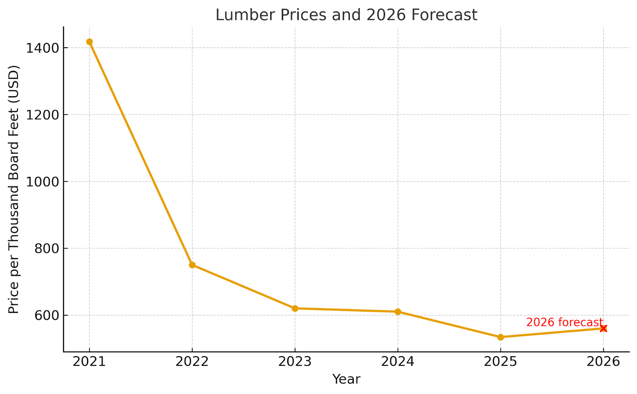
The laws of supply and demand kicked into high gear. With an imbalance of available lumber against consumer demand, lumber prices skyrocketed. Lumber price charts show prices spiking by about 280%, or more than doubling with prices peaking at $1,418 per thousand board feet in May 2021.
2. A Housing Boom
The pandemic housing boom compounded matters more. Throughout 2020 and 2021, the real estate market was a seller’s dream. Many who lived in crowded urban areas looked to leave while existing homeowners found they needed bigger spaces. With a limited inventory of homes for sale, house prices skyrocketed.
Those who turned to new construction for their next home found themselves competing for a limited supply of building materials.
3. Supply Chain Disruption
Though lumber production had mostly resumed both domestically and abroad, the supporting supply chain never fully recovered.
Both in the U.S. and internationally, ports and delivery services found themselves short-staffed or still operating under restrictive public health guidelines. With limited workers, the ability to process goods at pre-pandemic level was nearly impossible. Shipping prices – from container costs to transit expenses – increased to make up for budget shortfalls.
Compounding matters more – consumer demand hasn’t let up either. Again, the laws of supply and demand apply, keeping prices well above where they were before the pandemic (more in this in a minute).
Timber! Will Down Go Lumber Prices in 2026?
What’s next for lumber prices in 2026?
Lumber prices remain well below the pandemic peaks but are unlikely to return to pre-pandemic levels.
As of late 2025, prices climbed to $610 per thousand board feet, reflecting a steady demand and ongoing supply constraints. The National Association of Home Builders (NAHB) reported that the framing lumber composite price increased by 2.9% for the week ending November 1, 2024 – the fifth consecutive weekly increase. Lumber prices are now 17.2% higher than they were at the same time last year.
Looking ahead to 2026, construction activity is expected to stay uneven. Total housing starts reached 1.32 million units in mid-2025, but most of that growth came from multifamily projects. Single-family starts fell 4.6%, and builder confidence remains low due to high mortgage rates and higher material costs driven in part by new tariffs. Together, these factors suggest lumber prices may fluctuate rather than fall in 2026.
Increased Demand for New Homes
The housing market continues to face significant demand pressures.
Zillow’s 2025 analysis highlighted a shortfall of 4.7 million homes, an increase from the 4.5 million deficit reported in 2024.
While strong construction activity has helped slow the increase, it hasn’t been enough to close the gap created by years of underbuilding. With affordability stretched and more families sharing homes, new construction remains a priority heading into 2026.
But what’s keeping lumber prices higher than what was considered “normal” increases year over year for decades?
Several of the same pressures that drove them up to begin with are still in play.
- Reduced lumber production: In British Columbia, a major global timber supplier, lumber production remains constrained. Wildfires in 2023 damaged about 1.4 million hectares of forest, creating long-term supply challenges. Canadian output was still down about 6.9% in 2025, with regulations and limited harvests continuing to affect North American markets.
- Labor shortages: The industry still hasn’t recovered from workers lost during the Great Recession, and an aging labor force and tighter immigration policies keep the labor pool limited. Immigrants make up about 30% of construction workers, so new restrictions could strain supply further and push project costs higher.
- Supply chain logistics: Higher shipping costs and new environmental rules continue to add strain to material supply. The AWS outage in late 2025 showed how reliant the industry has become on cloud infrastructure, while growing automation across distributors is reshaping how materials move through the supply chain.
Reduce the Impact of Lumber Prices Regardless of World Events
While there’s no way to insulate an industry from the effects of a global event, there are ways to reduce their impacts. For custom home builders, partnering with a building materials supplier that has an established network and efficient construction method brings some stability to materials costs.
Affiliating With a Building Materials Supplier
Why does partnering with a building materials supplier help mitigate costs?
Strength in numbers.
With a collective of construction companies working through a single source, purchases of commodities such as lumber are made in bulk.
Like prices going up because of a limited supply trying to meet increased demand, bulk purchases take on the laws of economics in a different way. Items bought in smaller quantities require more resources – whether it’s manpower or packaging materials – to make their way from the manufacturer to your doorstep.
Purchasing items in large orders drives down the cost per unit – even if it’s by a few pennies – as there’s ultimately less work and other materials, such as packaging, involved. In bulk purchases, pennies saved add up quickly to a noticeably lower price.
Home Construction That’s Efficient
Another way custom home builders can control construction costs is by building homes using a process rooted in efficiency. Panelized construction is designed to do just that.
Through panelized construction, a home’s wall panels and other structural components are built off-site in a factory. In creating the parts of a home in a factory setting, there are controls over the amount of materials used and how far they go.
Materials are ordered in exact quantities and assembled to specific measurements, eliminating waste. In other words, there isn’t much useless scrap left over from that bulk order of lumber. The client only pays for the materials actually needed to create their next home.
Once delivered to the construction site, a panelized home goes up quickly, with no need for additional materials to assemble it.
How Can Builders Prepare if Lumber Prices Don’t Go Down in 2026?
Lumber prices may continue to shift, but builders can take steps to keep costs steady. Partnering with a trusted building materials supplier offers pricing stability through bulk purchasing and consistent supply.
Pairing that partnership with efficient methods like panelized construction helps reduce waste and control expenses. Together, they create a practical way to manage budgets – even if lumber prices don’t go down in 2026.
Ready to Build Smarter in 2026?
Learn how Barden’s panelized construction process and dealer network help builders stay competitive, even when material prices fluctuate.

This article was published in July of 2021 and was recently updated to reflect current industry trends.
